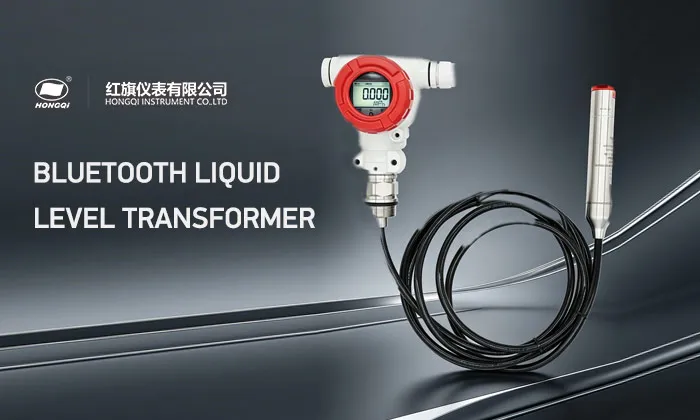
1. Basic product information
Definition: Bluetooth liquid level transmitter is a device that can convert physical liquid level quantities into transferable signals and transmit data through Bluetooth technology. It is generally used in various scenarios that require monitoring of liquid level height, such as industrial storage tanks, water tanks, sewage treatment tanks, etc.
Appearance description: It usually introduces the external dimensions, materials, interface forms, etc. of the transmitter. For example, it may be a compact and lightweight design, with a corrosion-resistant engineering plastic or metal shell and standard threaded interfaces for installation on containers.
2. Working Principle
Principle of liquid level detection: Common types include static pressure, capacitance, ultrasonic, etc. Taking static pressure as an example, it is based on the principle that liquid static pressure is proportional to the liquid level height, and calculates the liquid level height by measuring the pressure of the liquid on the bottom of the transmitter. The pressure sensor converts the pressure signal into an electrical signal and processes it to obtain liquid level data.
Bluetooth transmission principle: The transmitter integrates a Bluetooth module inside, which encodes and modulates the processed liquid level data according to the Bluetooth communication protocol and sends it out in the form of wireless RF signals. After successful pairing, nearby Bluetooth enabled receiving devices (such as mobile phones, tablets, industrial control terminals, etc.) can receive and parse this data.
3. Performance parameters
Measurement range: Clearly define the minimum and maximum liquid level values that the transmitter can measure. For example, the measurement range may be 0-10 meters, indicating that it can accurately measure any liquid level height within this range.
Accuracy: Reflects the degree to which the measurement results are close to the true liquid level value. For example, an accuracy of ± 0.5% FS (full scale) means that the measurement error will not exceed ± 0.5% of full scale throughout the entire measurement range.
Response time: refers to the time required for the transmitter to respond to changes in liquid level and output accurate data. A fast response time (such as less than 1 second) is important for real-time monitoring of liquid level changes.
Operating temperature range: Refers to the temperature range in which the transmitter can operate normally. Exceeding this range may affect its performance or even cause damage. For example, -20 ℃ -80 ℃ indicates that the transmitter can operate stably within this temperature range.