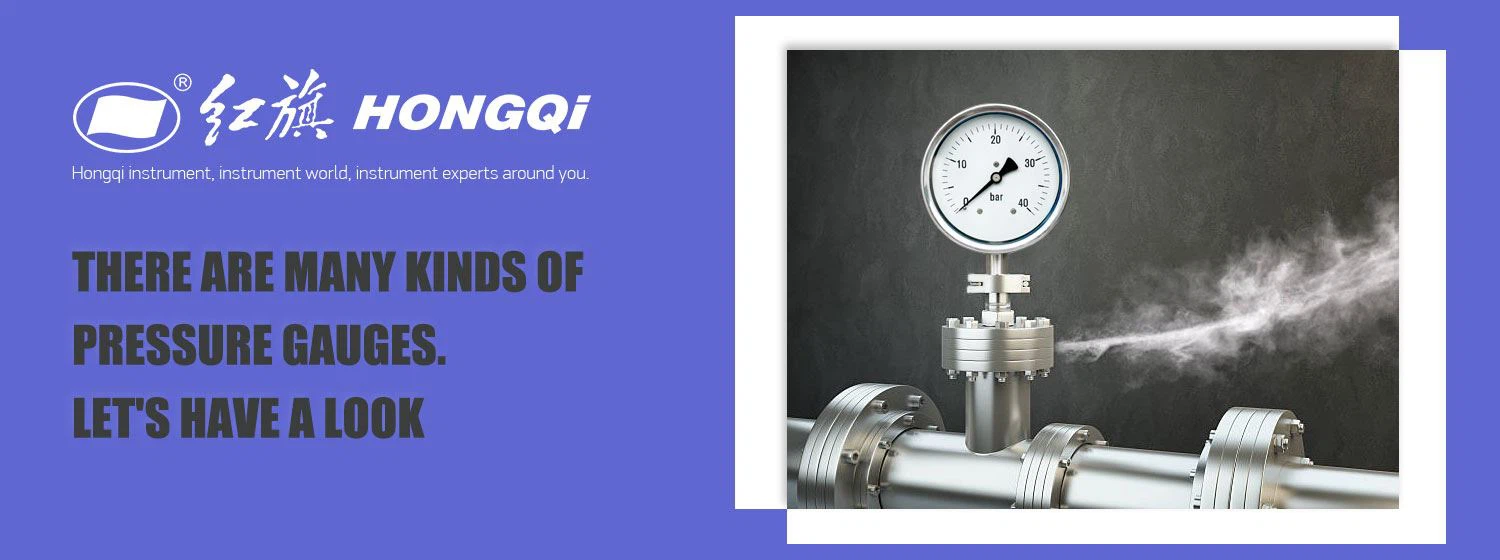
There are many kinds of pressure gauge, it not only has a general (ordinary) pointer indicator type, and digital type; There are not only regular types, there are special types; Not only the contact type, but also the far-pass type; There are not only vibration resistant type, but also seismic type; There are not only diaphragm type, but also corrosion resistant type.
Pressure gauge series complete. It has not only regular series, but also digital series; There are not only ordinary media application series, but also special media application series; There are not only switch signal series, but also remote signal series and so on, which are derived from practical needs and have formed a complete series. Pressure gauge specifications and models complete, perfect structure. From the nominal diameter, there are φ 40mm, φ 50mm, φ 60mm, φ 75mm, φ 100mm, φ 150mm, φ 200mm, φ 250mm and so on. From the installation structure type, there are direct installation type, embedded type and convex mounted type, which embedded type is divided into radial embedded type and axial embedded type, convex mounted type also has radial convex mounted type and axial convex mounted type. Direct installation type, divided into radial direct installation type and axial direct installation type. The radial direct installation type is the basic installation type, generally in the absence of specified installation structure type, refers to the radial direct installation type. Axial direct mounting takes into account the stability of its own support and is generally only used on pressure gauges with nominal diameters less than 150mm. The so-called embedded type and convex type pressure gauge, is we often say with the edge (installation ring) pressure gauge. Axial embedding type both axial front edge, radial embedding type refers to the radial front edge, radial convex mounting type (also called wall mounting type) refers to the radial after the edge of the pressure gauge. In terms of range and range, the positive pressure range is divided into micro pressure range, low pressure range, medium pressure range, high pressure range and ultra-high pressure range. Each range is divided into several measuring ranges (instrument range). In the area of negative pressure (vacuum) there are three kinds of negative pressure (vacuum gauge); Pressure gauge of positive pressure and negative pressure connection is a kind of pressure gauge across the volume domain. Its specification name is pressure vacuum gauge, also known as vacuum pressure gauge. It can measure not only positive pressure, but also negative pressure. The accuracy classification of the pressure gauge is very clear. Common accuracy levels are 4, 2.5, 1.6, 1, 0.4, 0.25, 0.16, 0.1 and so on. The accuracy level should generally be marked on the dial, and the mark has corresponding provisions. For example, "①" indicates that the accuracy level is 1. For some pressure gauges with very low accuracy, such as level 4, and some do not need to measure the exact pressure value, only need to indicate the pressure range, such as the pressure gauge on a fire extinguisher, can not mark the accuracy level.
Pressure gauge according to its measurement accuracy: can be divided into precision pressure gauge, general pressure gauge. The measurement accuracy of precision pressure gauge is 0.1, 0.16, 0.25, 0.4 and 0.05 respectively. General pressure gauge measurement accuracy grade is 1.0, 1.6, 2.5, 4.0.
Pressure gauge according to its measuring datum: pressure gauge according to its indicating pressure datum, divided into general pressure gauge, absolute pressure gauge stainless steel pressure gauge, differential pressure gauge. General pressure gauge to atmospheric pressure as the benchmark; Absolute pressure gauge to absolute pressure zero as the benchmark; A differential pressure gauge measures the difference between two pressures being measured.
According to its measuring range, the pressure gauge is divided into vacuum gauge, pressure vacuum gauge, micro pressure gauge, low pressure gauge, medium pressure gauge and high pressure gauge. Vacuum gauge for measuring pressure values less than atmospheric pressure; Pressure vacuum gauge is used to measure pressure values less than and greater than atmospheric pressure; Micropressure gauge is used to measure pressure values less than 60000 Pa; Low pressure gauge for measuring 0~6MPa pressure value; Medium pressure gauge for measuring 10~60MPa pressure value;
Pressure gauge according to its display mode: divided into pointer pressure gauge, digital pressure gauge.
Pressure gauge according to its use function points: pressure gauge according to its use function can be divided into local indication pressure gauge and live signal control pressure gauge.
General pressure gauges, vacuum pressure gauges, shockproof pressure gauges, stainless steel pressure gauges, etc., all belong to the local indicating pressure gauges, in addition to indicating pressure without other control functions.
Live signal control pressure gauge output signal mainly includes:
1, switch signal (such as electric contact pressure gauge)
2, resistance signal (such as resistance far-transmission pressure gauge)
3, current signal (such as inductive pressure transmitter, remote pressure gauge, pressure transmitter, etc.)
Pressure gauge can be divided into different characteristics of measuring medium:
1. General pressure gauge: general pressure gauge is used for measuring the pressure of liquid, gas or steam without explosion, crystallization and solidification, which has no corrosion effect on copper and copper alloy;
2, corrosion resistant pressure gauge: corrosion resistant pressure gauge is used to measure the pressure of corrosive media, commonly used stainless steel pressure gauge, diaphragm pressure gauge, etc.;
3. Explosion-proof pressure gauge: explosion-proof pressure gauge is used in dangerous places with explosive mixture in the environment, such as explosion-proof electric contact pressure gauge, explosion-proof transmitter, etc.
4, special pressure gauge.
According to the use of pressure gauge points: can be divided into ordinary pressure gauge, ammonia pressure gauge, oxygen pressure gauge, electrical contact pressure gauge, remote pressure gauge, vibration resistance pressure gauge, with the test pointer pressure gauge, double needle double tube or double needle single tube pressure gauge, digital display pressure gauge, digital precision pressure gauge, etc..
Common type
Bourdon tube pressure gauge: The bourdon tube sensitive element is an elastic C-shaped tube bent to a round shape with an elliptic cross-sectional area. The pressure of measuring medium acts on the inside of the wave tube so that the elliptical section of the Bourdon tube tends to be circular. Due to the small deformation of Bourdon tube, a certain ring stress is formed. This cyclic stress will cause bourdon tube to extend outward. Since the head of the elastic Bourdon tube is not fixed, it will produce a small deformation, the size of the deformation depends on the pressure of the measuring medium. The deformation of bourdon tube is indirectly indicated by the pointer through the movement to measure the pressure of the medium.
Diaphragm pressure gauge: the diaphragm sensitive element consists of two connected diaphragms showing circular waves. The pressure of the measuring medium acts on the inside of the membrane cavity, and the resulting deformation can be used to measure the pressure of the medium indirectly. The magnitude of the pressure value is indicated by the pointer. Diaphragm pressure gauges are generally used to measure gas pressure, and can measure micro pressure, overpressure protection is also possible to a certain extent. When several cartridge sensors are stacked together they produce a large transfer force to measure very small pressures.
Explosion-proof pressure gauge: explosion-proof pressure gauge suitable for use in flammable and explosive occasions, it is different from ordinary pressure gauge, explosion-proof pressure gauge requirements are higher, the first is high safety factor is not high, explosion-proof pressure gauge types are many, how to choose suitable for their own pressure gauge, it is about to consider the whole. Explosion-proof pressure gauge by explosion-proof coefficient points: intrinsically safe explosion-proof pressure gauge and explosion-proof pressure gauge. Safety performance: electric contact explosion-proof pressure gauge, pointer type explosion-proof pressure gauge, digital display explosion-proof pressure gauge.
Explosion-proof electric contact pressure gauge: Explosion-proof electric contact pressure gauge of flame-proof shell has the good explosion-proof performance, therefore the explosion-proof electric contact pressure gauge in normal work process because of the influence of the sparks or electric arc, in addition to shell under internal explosive gas mixtures at once an explosion caused by the explosion pressure, and can effectively prevent the resulting heat energy outward spread smoothly, And can only slowly diffuse outward along the small gap of the flameproof joint inside the shell. At this point, the instantaneous temperature transmitted to the outside of the shell has been reduced to the explosive gas mixture of the ignition point temperature, so it will not lead to detonation.
Explosion-proof digital (pointer) display pressure gauge: high precision, high stability, error ≤1%, internal power supply, micro power consumption, stainless steel shell, strong protection, beautiful and delicate. Explosion-proof digital display pressure gauge is widely used in petroleum, chemical industry, metallurgy, power station and other industrial departments or mechanical and electrical equipment supporting the measurement of various fluid media pressure has the danger of explosion.
Vacuum pressure gauge: vacuum pressure gauge is used to measure the pressure or negative pressure of liquid, gas or steam medium which has no corrosive effect on steel, copper and copper alloy and has no explosive danger and does not crystallize or solidify. The shockproof vacuum pressure gauge is used to measure the negative pressure of non-corrosive, non-crystallizable media under vibration and pressure fluctuations. Electric contact pressure vacuum gauge and electric contact vacuum gauge for copper and copper alloy without corrosion, no explosion danger of amorphous, non-solidified liquid, gas and other media (pressure) and negative pressure measurement, when the pressure reaches a predetermined value, with the help of contact device, can be connected or disconnected control circuit, while sending electrical signals.
Vacuum pressure gauge classification:
Vacuum pressure gauge is based on atmospheric pressure, used for measuring greater than or less than atmospheric pressure instrument.
Shockproof vacuum pressure gauge is a classification of shockproof pressure gauge. It is used for measuring the negative pressure of non-corrosive and non-crystallized media under vibration and pressure fluctuation.
Electric contact vacuum pressure gauge and electric contact vacuum gauge Copper and copper alloy no corrosion, no explosion danger of non-crystallized non-solidified liquid, gas and other media (pressure) and negative pressure.
Stainless steel pressure and vacuum gauge is used to measure the pressure and negative pressure of stainless steel 316,316L and 0Crl8Ni12MO2Ti non-corrosive liquid and gas medium. All stainless steel has better corrosion resistance to the environment.
Acidproof pressure vacuum gauge is used to measure the pressure and negative pressure of nitric acid and alkali liquid medium; Acidproof vacuum gauge is used to measure the negative pressure of nitric acid and alkali liquid.
Basic terminology
1, positive pressure and negative pressure
2. Relative pressure and absolute pressure
3, vacuum degree
4. The expression method of pressure
There are two ways to express pressure: one is the pressure expressed by absolute vacuum as the benchmark, called absolute pressure; The other is the atmospheric pressure as a benchmark expressed by the pressure, known as the relative pressure. Since the pressure measured by most pressure meters is relative pressure, the relative pressure is also called gauge pressure. When the absolute pressure is less than the atmospheric pressure, the absolute pressure in the container is less than one atmosphere. This is called "vacuum degree". Their relationship is as follows:
Absolute pressure = atmospheric pressure + relative pressure
Vacuum = atmospheric pressure - absolute pressure
China's legal pressure unit is Pa (N/㎡), known as the PASCAL, abbreviated as Pa. Because this unit is too small, its 10^6 unit of MPa (mega pas) is often used.