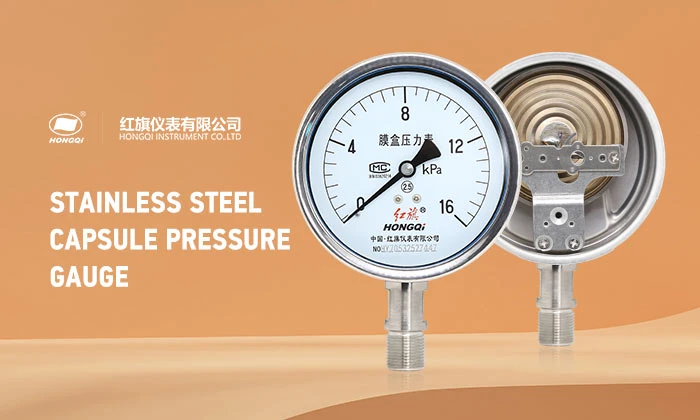
This pressure gauge is made of stainless steel material and has good corrosion resistance. It is suitable for measuring micro pressure and negative pressure of gases or liquids that have no corrosive effect on stainless steel. Its working principle is based on the deformation of elastic elements (membrane boxes) under pressure, and the corresponding pressure value is indicated by the pointer driven by the transmission mechanism.
The accuracy levels of bellows pressure gauges usually include the following:
1.0 level: indicates that the allowable error of the pressure gauge is ± 1.0% of the full range. For example, a 1.0 level bellows pressure gauge with a full range of 100kPa has an allowable error range of ± 1kPa.
Level 1.6 (also known as Level 1.5): The allowable error is ± 1.6% of the full scale. The allowable error range for a 1.6-level bellows pressure gauge with a full range of 100kPa is ± 1.6kPa.
Level 2.5: The allowable error is ± 2.5% of the full scale. For a 2.5-level bellows pressure gauge with a full range of 100kPa, the allowable error range is ± 2.5kPa.
Level 4.0: The allowable error is ± 4.0% of the full scale. If the full range is 100kPa, the allowable error range is ± 4kPa.
Membrane pressure gauges with different precision levels are suitable for different measurement scenarios. High precision pressure gauges are used in applications that require high measurement accuracy, such as laboratories and precision industrial measurements; Lower precision pressure gauges can be used for general industrial measurements or daily monitoring scenarios that do not require high precision.
When selecting a bellows pressure gauge, the following principles can be used to determine the accuracy level based on the measuring medium:
A clean and stable medium
For clean and stable gases such as air and nitrogen, as well as clean liquids like purified water, under general measurement requirements, choosing a 2.5-level or 4.0 level diaphragm pressure gauge can meet the needs. Because these media will not have adverse effects such as corrosion or blockage on the measurement system of the pressure gauge, lower precision level pressure gauges can provide reliable measurement results. For example, in a typical air conditioning system, using a 2.5-level or 4.0 level bellows pressure gauge can accurately reflect the pressure situation of the system when measuring air pressure.
If precise gas pressure measurement is required in some experimental environments with high pressure measurement accuracy, such as scientific research laboratories, or measuring water pressure in high-precision water treatment systems, high-precision bellows pressure gauges of 1.0 or 1.6 level can be selected to ensure the accuracy and reliability of measurement data.
corrosive media
When measuring highly corrosive liquids or gases such as sulfuric acid and hydrochloric acid, the medium may corrode the internal components of the pressure gauge, affecting measurement accuracy. Therefore, it is recommended to prioritize the selection of high-precision membrane box pressure gauges with 1.0 or 1.6 grades. This is because high-precision pressure gauges usually use higher quality corrosion-resistant materials and are more refined in manufacturing processes, which can better resist the erosion of corrosive media and ensure high measurement accuracy over a certain period of use. For example, in chemical production, high-precision diaphragm pressure gauges can more accurately reflect pressure changes when measuring the pressure of corrosive gases or liquids, providing reliable pressure data for the production process and helping to adjust production parameters in a timely manner to ensure production safety and product quality.
For some relatively weak corrosive media, such as weak acid and weak alkali solutions, a 1.6 or 2.5 level diaphragm pressure gauge can also be selected, but it should be comprehensively judged based on specific measurement requirements and usage environment. If there is a certain requirement for measurement accuracy and the usage environment is harsh, it is recommended to choose a pressure gauge with a rating of 1.6; If the measurement accuracy requirement is not high and the usage environment is relatively good, a 2.5-level pressure gauge can also meet the basic measurement needs.
Viscous or easily crystallizable medium
For viscous liquids such as heavy oil and asphalt, or media that are prone to crystallization, it is generally necessary to choose a 1.0 or 1.6 level diaphragm pressure gauge with higher accuracy because it may block the pressure tap of the pressure gauge or affect the normal deformation of the diaphragm box, resulting in increased measurement errors. This can to some extent compensate for measurement errors caused by the characteristics of the medium and ensure the accuracy of the measurement results. For example, in the petrochemical industry, high-precision diaphragm pressure gauges can more accurately reflect the pressure of heavy oil when measuring its pressure, providing reliable basis for production operations.
If the measurement accuracy requirements are not particularly high in practical applications and effective anti clogging and anti crystallization measures are taken, such as installing suitable filters or heat tracing devices, it is also possible to consider using a 2.5-level diaphragm pressure gauge, but regular maintenance and calibration of the pressure gauge are needed to ensure that its measurement accuracy is within the allowable range.