


On the morning , the Yueqing City Federation of Trade Unions and the Liushi Town Federation of Trade Unions invited Zhejiang craftsmen to visit the enterprise and conduct public welfare classes on "Filial Piety First" and "Rice Sculpture" for the summer "Love Class" of Hongqi Instrument Co., Ltd.
What is filial piety? How to achieve filial piety? Teacher Zheng helped children clearly understand the origin of the character 'filial piety' through its evolution.
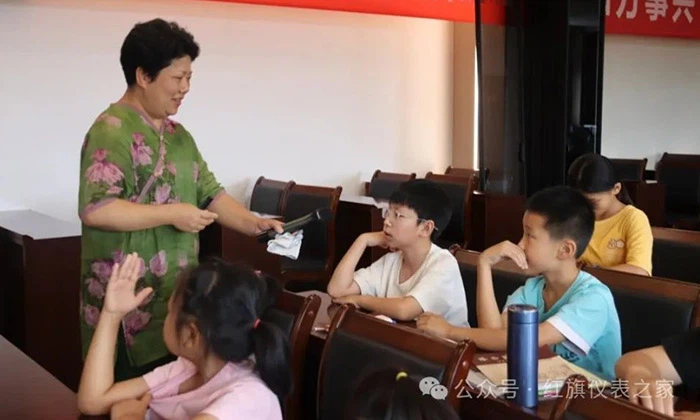
Teacher Zheng also told the children the story of crows feeding back and lambs kneeling to suckle, helping them understand gratitude; Tell the story of the great director's collection of breast milk turning from milky white to blood red, allowing children to understand the greatness of maternal love. This series of stories allows children to understand filial piety more deeply, feel filial piety, and express filial piety.

By asking questions and letting children express themselves on how to be filial in life, their answers are touching: some children say they help their parents with household chores; Some children say they help their mothers take care of their younger siblings; Some children say they don't want to make their mothers angry; Some children say they should study hard and be a good child Filial piety is not difficult, it is everywhere, simple yet great. Rice sculpture, also known as powder sculpture, is a traditional folk craft unique to Wenzhou, Zhejiang Province. Along with the northern "noodle sculpture", it is known as the double masterpiece of food sculpture craftsmanship.

Teacher Zheng told the children about the long history of rice sculpture. According to records, the folk custom of making rice sculptures in Wenzhou dates back to the Song Dynasty and has a history of over a thousand years. It is often used for occasions such as birthday celebrations, weddings, banquets, and Buddhist ceremonies. Teacher Zheng also teaches children to read rice sculptures in Yueqing dialect, which is novel and fun for them.
After introducing the history of rice sculpture, Teacher Zheng taught the children to experience rice sculpture production. The teacher distributed colorful rice plastic materials to the children and personally demonstrated the production process. The children had a great time playing, and with their small and skillful hands, cute works were presented one by one. After the end, the children went on stage one after another to explain their works. Some children have expressed that I have studied Teacher Zheng's rice sculpture class last year, but I still want to learn from Teacher Zheng's class again. This handicraft class will help children understand how to make rice sculptures. The children all said that this course was very lively and interesting, and it was an unforgettable experience in their lives.


