


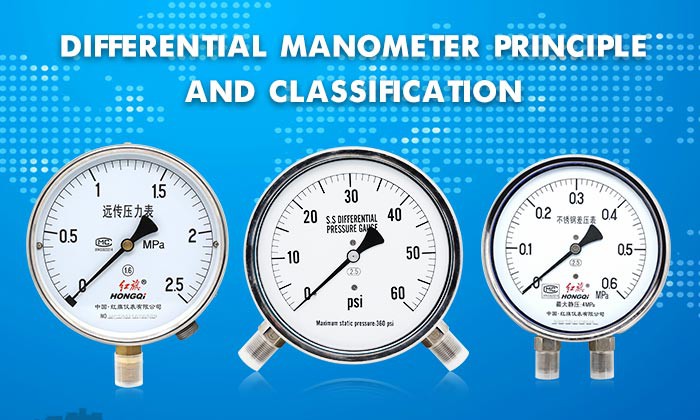
When the fluid filled with the pipe flows through the throttle piece in the pipe, the velocity will form a local contraction at the throttle piece, so the flow rate increases and the static pressure decreases, and then the pressure difference will be generated before and after the throttle piece. The greater the fluid flow, the greater the pressure difference, so that the flow can be measured according to the pressure difference. This measurement method is based on the continuity equation of flow (law of conservation of mass) and Bernoulli equation (law of conservation of energy). The size of the differential pressure is not only flow and many other factors, such as when the throttle device form or the physical properties of the fluid in the pipeline (density, viscosity), at the same size of the flow under the pressure difference is different.
Differential manometers are commonly used in the industry to measure the difference in pressure between two points. This device works on the principle of balancing liquid columns in two or more legs of a U-shaped tube, with each leg filled with a different fluid. The difference in pressure between the two points is determined by measuring the height difference between the two fluid columns.
Differential manometers can be classified into two categories: simple and inclined.
Simple Differential Manometers:
Simple differential manometers consist of a U-tube that is partially filled with a liquid. The two legs of the tube are open to the atmosphere, and a pressure tap is connected to each of the two points that need to be measured. The pressure difference between the two points is measured by observing the difference in the height of the two columns of liquid.
Inclined Differential Manometers:
Inclined differential manometers work on the same principle as simple differential manometers. However, they have an inclined U-tube with one leg vertical and the other leg inclined at a certain angle. The pressure difference is determined by measuring the height difference between the two fluid columns.
Differential manometers are widely used in the industry for various applications such as measuring flow rates of fluids in pipes, monitoring air pressure in HVAC systems, and measuring pressure in machinery and equipment.
In conclusion, the differential manometer principle is simple and effective, making it a popular choice for measuring pressure differences in a range of industries. Simple and inclined differential manometers are two types that are used in various applications, and both are reliable and accurate.


